

Why Professional Website Design Matters
Your website is often one of the first places potential customers encounter your business. It represents your brand, explains your products or services and helps people decide whether they want to take the next step.
Professional website design, however, is about much more than making a website look attractive. A successful business website needs to combine clear objectives, useful content, intuitive navigation, good user experience and effective technology.
When these elements work together, your website becomes more than an online presence — it becomes a practical business tool.
Your Website Shapes the First Impression of Your Business
Potential customers can form an impression of a business very quickly from its website.
An outdated design, confusing navigation or poorly presented information can create uncertainty, even when the business itself provides an excellent service. Conversely, a clear, professional website helps visitors understand who you are, what you offer and where they should go next.
Good design should support the content rather than compete with it. The objective isn’t simply to impress visitors visually; it is to make their experience of your business clear, straightforward and reassuring from the moment they arrive.
Building Credibility and Trust
People naturally look for signs that a business is genuine and credible before making an enquiry or purchasing something.
A professionally designed website can help establish that confidence by presenting accurate business information clearly and consistently. Customer testimonials, case studies, professional experience, accreditations and clear contact information can all provide useful reassurance.
Content also plays an important role. A business that demonstrates its knowledge and experience through useful, well-written content gives potential customers another reason to trust its expertise.
Professional presentation alone cannot create credibility, but good website design can make the evidence of that credibility much easier for visitors to recognise.
Creating a Better User Experience
User experience, or UX, considers how easily people can use your website and accomplish what they came there to do.
Visitors shouldn’t have to work out how your website is organised. Navigation should be logical, important information should be easy to find and pages should guide people naturally towards the next relevant step.
That experience also needs to work across different devices. A website should be straightforward to use whether somebody visits from a desktop computer, tablet or mobile phone.
Accessibility should be considered as part of the same process. Designing websites so that they can be used by as many people as possible isn’t simply good practice; it contributes to a better experience for everyone.
Building a Strong Foundation for Search Visibility
Website design and development can also provide the foundations for effective Search Engine Optimisation (SEO).
A logical site structure, clear headings, useful content, internal linking, mobile usability and good technical performance can all make it easier for search engines to access and understand a website.
Professional website design doesn’t automatically guarantee high search rankings. SEO is an ongoing process involving content, technical optimisation, authority, competition and many other factors.
However, considering SEO when a website is being planned and built provides a much stronger starting point than attempting to address fundamental structural problems later.
Helping Visitors Take the Next Step
A business website normally has a purpose.
You might want visitors to make an enquiry, request a quotation, book a consultation, telephone you, visit your premises, download information or purchase a product.
Professional website design considers those objectives from the beginning.
Clear calls to action and straightforward contact routes help visitors understand what they can do next. Forms should ask for the information genuinely required, contact details should be easy to find and unnecessary obstacles should be removed from important customer journeys.
The aim isn’t to pressure visitors into taking action. It is to make the next step obvious and easy when they are ready to take it.
Professional Website Design Is More Than Appearance
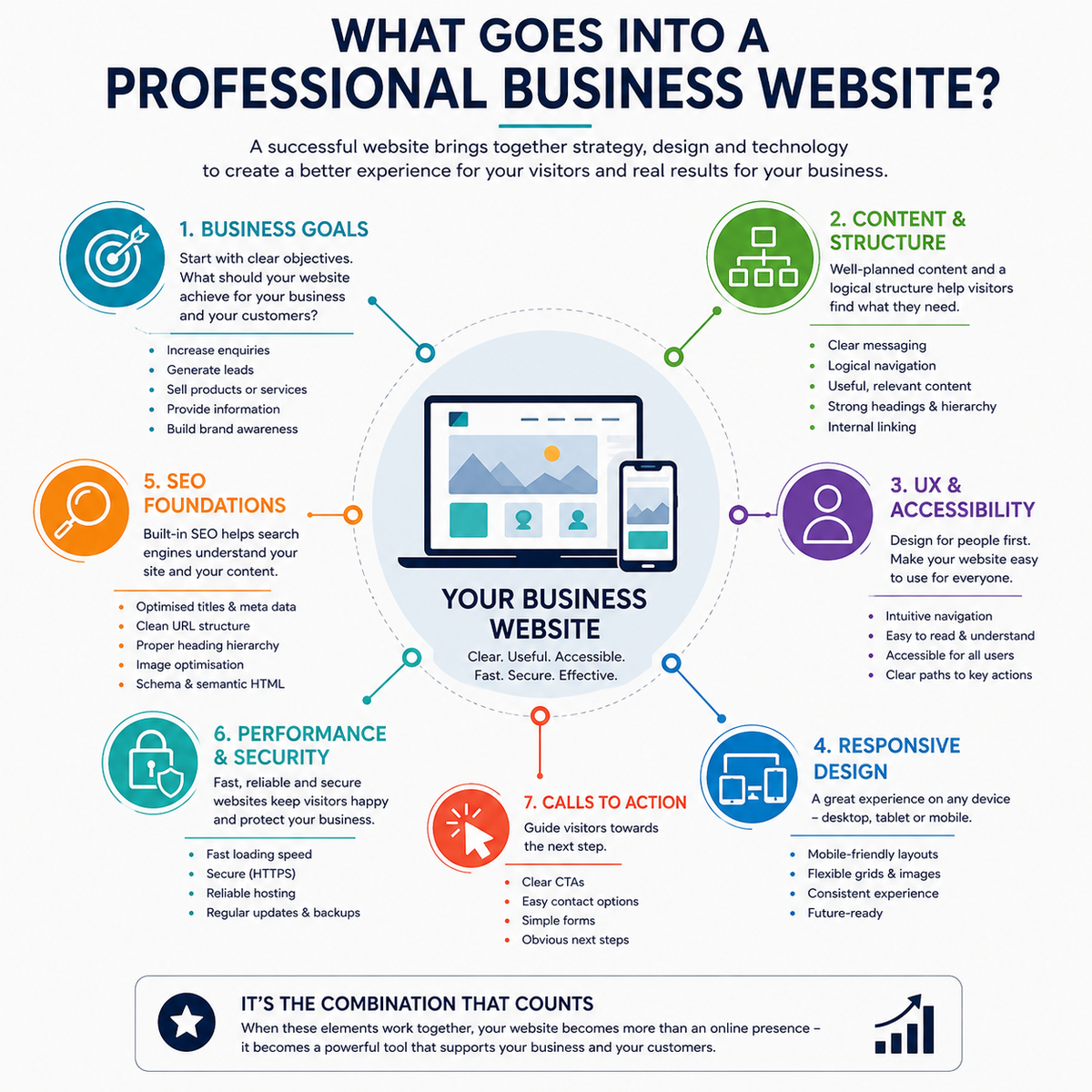
A successful website brings together a number of disciplines.
It starts by understanding the business, its customers and what the website needs to achieve. From there, consideration can be given to content and information structure, user experience, accessibility, responsive design, search visibility, performance, security and the technology used to build the site.
These elements shouldn’t exist independently. Decisions about one area frequently affect another.
For example, an attractive page that loads slowly can frustrate visitors. Excellent content that is difficult to navigate may never be found. A technically impressive website that doesn’t clearly explain the business is unlikely to achieve its objectives.
Professional website design is therefore about finding the right balance between business requirements, customer needs, design and technology.
A Website Designed Around Your Business
There is no single formula for the perfect business website because every business has different customers, objectives and priorities.
For some businesses, the website primarily needs to generate enquiries. For others, it may support existing customers, demonstrate expertise, provide information or sell products and services directly.
The important thing is that decisions about the website are driven by those requirements rather than by design trends or technology alone.
A professionally planned, designed and developed website should support the way your business works today while providing a foundation that can adapt as your business and the digital landscape continue to change.