
Is Your Business Visible in Modern Search Results?
Introduction
When someone searches for a product, service or information online, your website is competing for attention within a search results page that looks very different from the simple list of website links many of us remember.
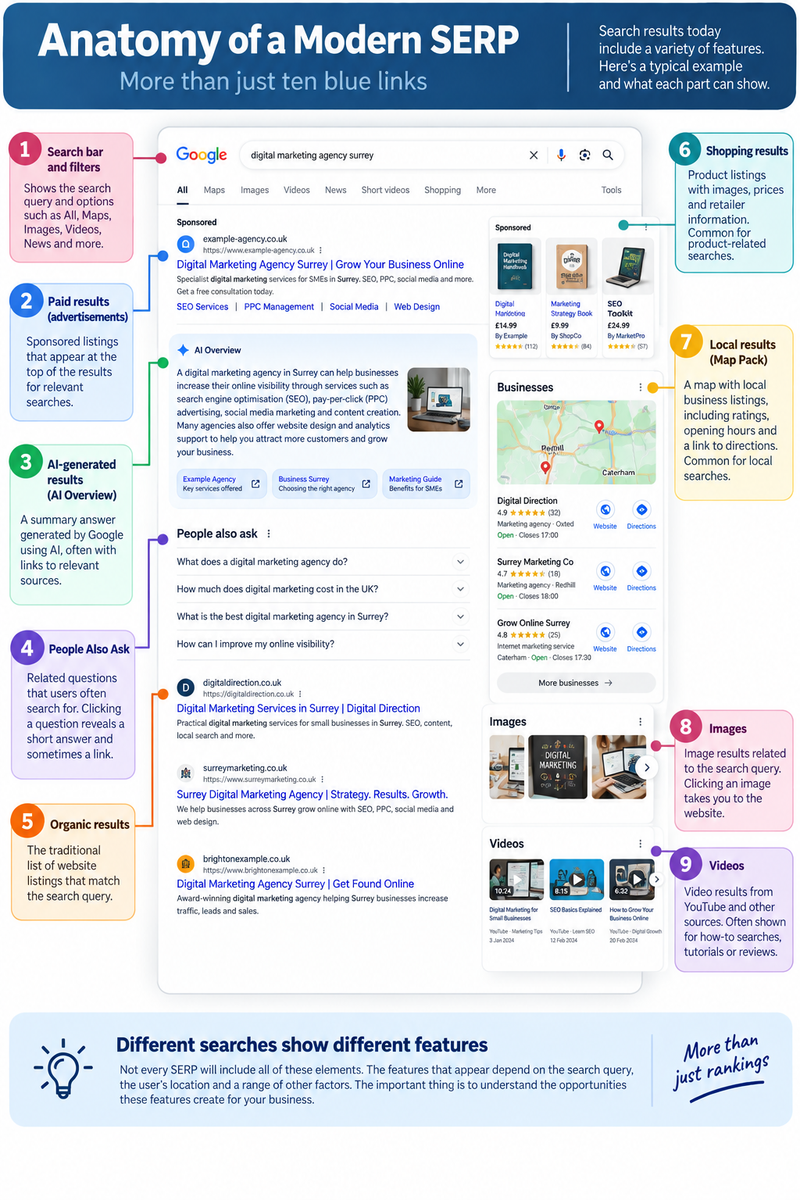
Today’s search results can include advertisements, maps and local businesses, images, videos, related questions and AI-generated answers alongside traditional organic website listings.
For small businesses, this creates both challenges and opportunities. Ranking well organically remains valuable, but it is no longer the only way your business can become visible in search.
A potential customer might discover you through your Google Business Profile, encounter an image or video from your website, see your content referenced within another search feature or find one of your pages within the traditional organic results.
This means that understanding your search visibility requires looking at the whole results page rather than concentrating on a single ranking position.
In this article, we’ll look at what modern search results mean for your business and some practical ways to identify where you are visible — and where there may be opportunities to improve.
Search Results Have Changed
Search results were once relatively straightforward. You entered a search, and Google returned a page dominated by links to websites ranked according to their relevance.
That familiar organic list still exists, but it now shares the page with many other types of result.
Depending on what someone searches for, they might see paid advertisements, a local map with nearby businesses, images, videos, shopping results, related questions or an AI-generated overview before reaching some of the traditional organic listings.
The results can also change according to the type of search being made. Someone looking for a nearby service is likely to see a very different results page from someone researching a subject or comparing products.
For businesses, this changes the way we should think about search visibility. The question is no longer simply, “Where does my website rank?”
A better question is:
“Where and how does my business appear when potential customers search?”
That broader view can reveal opportunities that concentrating solely on traditional website rankings might miss.
Your Website Ranking Is Only Part of the Picture
Achieving a strong organic ranking is still an important objective. A prominent website listing can bring relevant visitors to your site and help potential customers discover your products or services.
But ranking positions alone no longer tell you the whole story.
A business might appear prominently in a local Map Pack even when its website is further down the organic results. Useful content could appear within a featured result or related question, while images and videos can provide additional ways for people to encounter the business.
The opposite can also happen. Your website might rank reasonably well, but competing businesses could attract more attention because they occupy other prominent areas of the results page.
This is why measuring search visibility should go beyond checking whether you rank first, fifth or tenth for a particular phrase.
What matters is whether your business is visible in the places your potential customers are most likely to notice and use. Understanding the complete search results page gives you a much clearer picture of how effectively your business is competing for that attention.
Local Search Can Put Your Business in Front of Customers
For businesses serving a particular town, region or local community, some of the most valuable search visibility may come from Google’s local results rather than a traditional website listing.
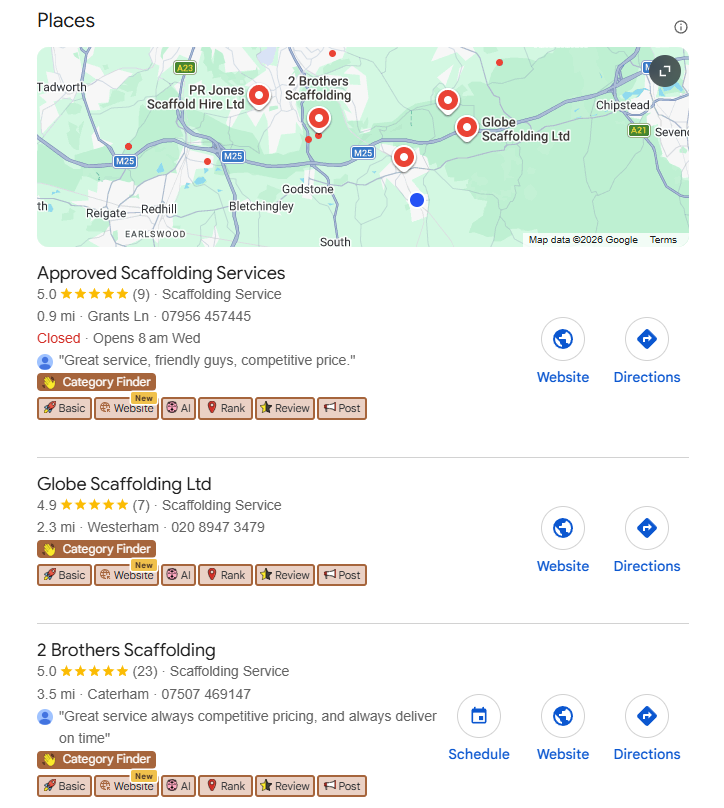
Searches for services such as electricians, accountants, restaurants or digital consultants can trigger a map accompanied by a selection of relevant local businesses. These results can give potential customers immediate access to information such as your location or service area, opening hours, reviews, photographs, telephone number and website.
Your Google Business Profile therefore plays an important role in how your business can appear for relevant local searches.
Keeping your profile accurate and complete, selecting appropriate business categories, adding useful photographs, encouraging genuine customer reviews and keeping your business information consistent across the web can all contribute to a stronger local presence.
For a small business serving a defined geographical area, appearing prominently within local search results can be just as valuable as achieving a strong traditional organic ranking.
It is another reason why assessing your online visibility means looking beyond your website alone.
AI, Images, Videos and Other Search Opportunities
Modern search results offer businesses more opportunities for visibility than traditional website listings alone.
Google can display images, videos, featured answers, related questions and other enhanced results when they are relevant to what someone is searching for. AI-generated results add another layer, bringing together information from different sources and providing links that allow people to explore the subject further.
For businesses, the important point is that useful content can potentially be discovered in several different ways.
A well-written guide might help answer a question a potential customer is asking. A useful photograph could appear within image results. A demonstration or explanatory video might provide another route to your business. Clear, well-structured website content can also make it easier for search engines and AI-powered search features to understand what your business knows and offers.
This doesn’t mean trying to optimise your website for every possible search feature.
Instead, concentrate on creating genuinely useful content in the formats that make sense for your customers. Written information, photographs, diagrams, infographics and videos can each play a part in building a broader presence in search.
The opportunity is no longer simply to get one website link onto a results page. It is to give search engines several useful ways to understand, present and potentially surface your business.
Five Ways to Review Your Search Visibility
You don’t need specialist software to begin understanding how visible your business is in search. Start with a small number of searches that a potential customer might genuinely use and examine the complete results page.
1. Search for Your Important Services
Choose several products or services that matter to your business and search using the language you think potential customers would use. Don’t concentrate only on your business name — the objective is to see whether people who don’t already know you can discover you.
2. Look Beyond the Organic Listings
Examine the whole results page. Are there advertisements, local results, AI-generated answers, related questions, images or videos? Consider which of these features are most relevant to your business and where you currently appear.
3. Check Your Local Visibility
If you serve a particular geographical area, try searches that include the locations you cover. Look at the businesses appearing in the Map Pack and compare the information presented with your own Google Business Profile.
4. See How Your Competitors Appear
Notice which competitors repeatedly appear and where they are visible. They may have an organic listing, a strong local presence, useful images, videos or content answering common customer questions. This can highlight areas where your own online presence could be strengthened.
5. Repeat the Exercise Regularly
Search results continually evolve, so a review should not be a one-off exercise. Repeating a small set of important searches periodically can help you spot changes, identify new opportunities and understand whether your search visibility is improving.
The objective isn’t to appear in every possible part of a search results page. It is to identify the areas that matter to your customers and make sure your business has the strongest, most useful presence it reasonably can.
Look at the Whole Search Results Page
Search visibility is no longer about achieving a single ranking position for a particular keyword. Modern search results provide several different ways for a business to be discovered, and the opportunities available will depend on what your customers are searching for.
Your website’s organic rankings remain important, but they should be considered alongside your local presence, business information, reviews, images, videos and useful content that answers the questions your customers are asking.
Looking at the complete results page also helps you understand the competition more clearly. You can see which businesses are attracting attention, the types of content Google is displaying and where there may be gaps that your business could realistically fill.
The detailed Digital Strategy guide, “Anatomy of SERPs: Understanding Modern Search Results,” explores the different elements of today’s search results and what they mean for SEO.
The important thing is not to chase every new search feature. Concentrate on the searches that matter to your business, understand what appears for those searches and build your online presence around the opportunities most relevant to your customers.
How Visible Is Your Business in Search?
Potential customers may be searching for the products and services you provide every day. The important question is whether they are finding your business when they do.
Your website rankings are part of that picture, but modern search visibility can also involve local results, your Google Business Profile, reviews, images, videos and the useful information you publish online.
Understanding where your business currently appears — and where your competitors are gaining greater visibility — can help identify practical opportunities for improvement.
Our Small Business Digital Health Check provides a simple starting point for reviewing your wider online presence. If you would prefer an independent assessment, we can also look at how your business is currently performing online and help identify the areas where improvements could make the greatest difference.
Start by understanding where you are visible today, then you can make better decisions about where to concentrate your efforts next.