

How On-Page SEO Can Improve Your Business Website
Introduction
Many business websites are built, published and then left largely unchanged. The services may still be relevant and the information broadly correct, but individual pages are rarely reviewed to see whether they are as clear, useful and effective as they could be.
This is where on-page SEO can help.
On-page SEO involves improving the elements you control directly on your website, including the content, page titles, headings, internal links and images. The objective is not simply to make pages more attractive to search engines. Many of the same improvements can also make your website easier for potential customers to understand and use.
A well-optimised page should make it clear what the page is about, provide the information the visitor needs and make it easy to find related information or take the next step.
You don’t need to completely rebuild your website to start making improvements. Reviewing a few important pages and correcting obvious weaknesses can be a practical first step towards creating a clearer, more useful website with stronger search visibility.
Is It Clear What Each Page Is About?
Every important page on your website should have a clear purpose. Within a few moments of arriving, a potential customer should be able to understand what the page is about and whether it contains the information they are looking for.
This starts with understanding why someone might visit the page. A service page should clearly explain what you provide, who the service is for and how it can help. An article should answer the question or problem that brought the reader there in the first place.
Page titles, headings and content should all support that purpose. They should use clear, natural language rather than trying to include as many search terms as possible. If visitors have to work out what a page is trying to say, search engines may also have difficulty understanding its relevance.
It is worth reviewing some of the most important pages on your website from a customer’s perspective. Ask whether the title accurately describes the page, whether the headings make the content easy to scan and whether the information answers the questions a potential customer is likely to have.
Good on-page SEO starts with clarity. Make the purpose of each page obvious, provide the information people came looking for and make the next step easy to understand.
Make Your Pages Easier to Use
Good on-page SEO is closely connected with good user experience. If someone arrives on your website but finds the page difficult to read, slow to load or awkward to use on their phone, they may leave before discovering what your business has to offer.
Start with the basics. Content should be easy to scan, with clear headings, reasonably short paragraphs and enough space to prevent the page feeling cluttered. Important links and calls to action should be easy to recognise, and visitors should be able to move naturally to related information without having to search for it.
Internal links are particularly useful. Linking between relevant services, supporting information and articles helps visitors explore your website while also helping search engines understand how your pages relate to one another.
Images can make a page more engaging and help explain a subject, but unnecessarily large image files can affect performance. Images should be appropriately sized and optimised, with alternative text where it is needed for accessibility.
It is also important to check your pages on a mobile phone rather than assuming that a responsive website automatically provides a good mobile experience. Text should be comfortable to read, buttons and links easy to use, and forms straightforward to complete.
These may seem like small details, but together they can make the difference between someone struggling with your website and someone finding what they need and taking the next step.
Five On-Page SEO Improvements You Can Make
You do not need to optimise every page on your website at once. Start with the pages that are most important to your business — perhaps your homepage and the pages describing your main services — and look for straightforward improvements.
1. Review the Page as a Potential Customer
Look at the page with fresh eyes. Is it immediately clear what the page is about, who the service or information is for and what someone should do next? Remove outdated information and clarify anything that could cause confusion.
2. Check Your Page Title and Headings
Make sure the page title accurately describes the content and that headings divide the page into logical sections. Use the language your customers are likely to understand rather than trying to force search terms into every heading.
3. Improve Thin or Outdated Content
A page should provide enough useful information to answer the visitor’s main questions. Add missing information where it genuinely helps, but don’t add unnecessary text simply to make a page longer.
4. Add Useful Internal Links
Look for opportunities to link to relevant services, articles or supporting information elsewhere on your website. This helps visitors discover more useful content and helps search engines understand the relationships between your pages.
5. Check the Page on Your Phone
Open the page on a mobile phone and use it as a customer would. Check that the text is readable, navigation works properly, links and buttons are easy to use and any forms are straightforward to complete.
These five checks provide a simple starting point. Once your most important pages are working well, you can gradually apply the same approach across the rest of your website.
On-Page SEO Is Only Part of the Picture
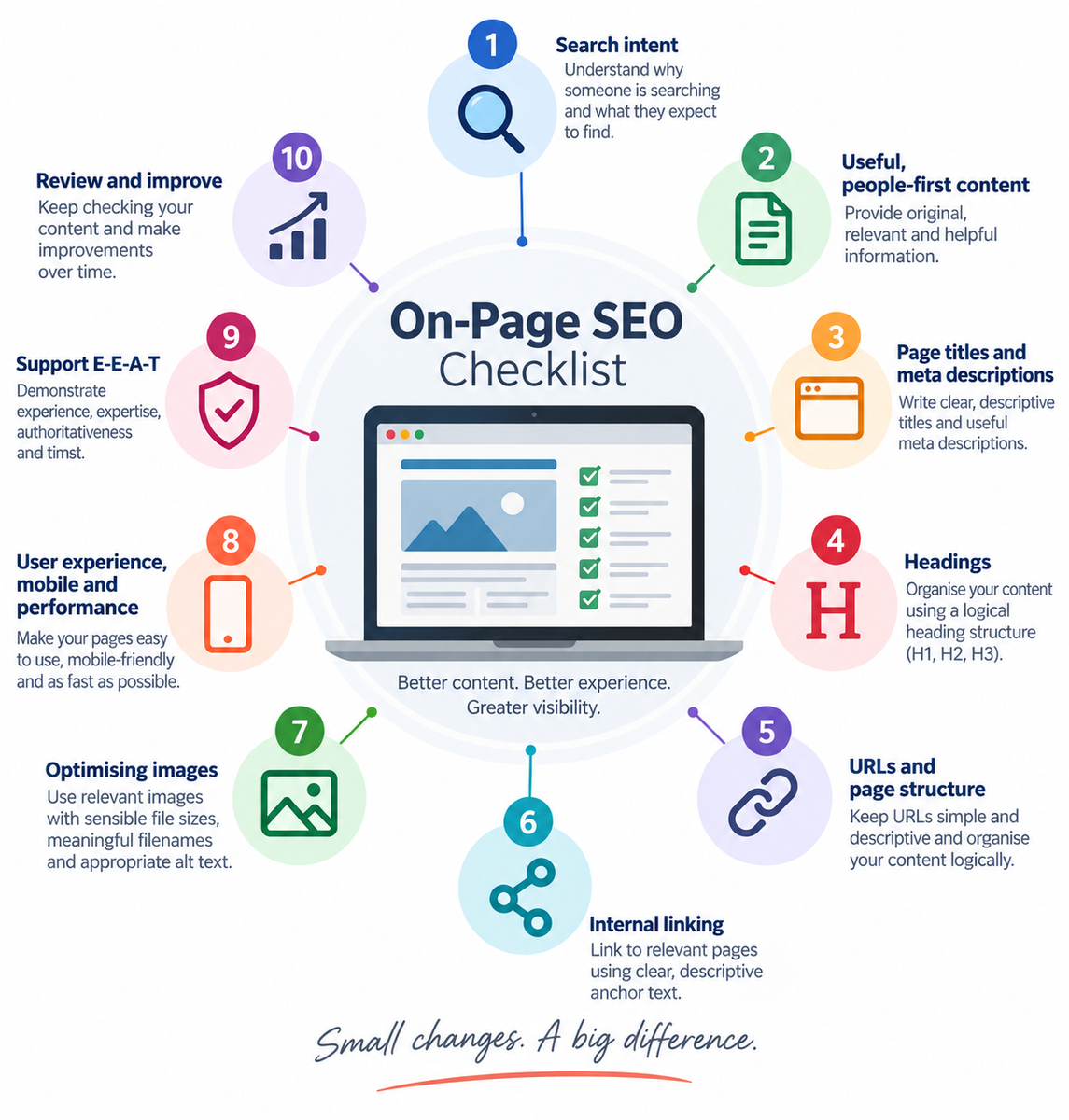
Improving individual pages can make your website clearer, more useful and easier for search engines to understand, but on-page SEO does not work in isolation.
Your overall search visibility can also be influenced by the technical health of your website, links and mentions from other websites, your local search presence and the authority and trust your business builds online. All of these elements work together.
This is why SEO is most effective when it is considered as part of your wider digital strategy rather than as a series of individual fixes.
If you would like to explore on-page optimisation in more detail, our Digital Strategy article, On-Page SEO: A Practical Guide to Optimising Your Website, looks more closely at search intent, content, page titles, headings, internal linking, images, user experience and E-E-A-T.
The important thing is not to try to improve everything at once. Start with the pages that matter most to your business, make practical improvements and build from there.
Would an Independent Review Help?
It can be difficult to assess your own website objectively. When you work with it regularly, it is easy to become familiar with the content and overlook problems that may be obvious to a potential customer visiting for the first time.
An independent review can help identify pages that are unclear, difficult to navigate, poorly structured or missing opportunities to support your search visibility. It can also help you decide which improvements are worth prioritising rather than trying to change everything at once.
Digital Direction provides practical SEO and digital consultancy for small businesses. We look at your website in the context of your wider online presence, identify areas that could be improved and help you decide where to focus your time and resources.
If you would like a useful starting point, you can also download our free Small Business Digital Health Check, which provides 10 practical ways to review and improve your online visibility.
Or, if you would prefer to discuss your website and the areas where you may need help, book a consultation with Digital Direction.