

How E-E-A-T Can Strengthen Your Business’s Online Credibility
Building trust online is about more than having a professional-looking website. The experience and expertise you demonstrate, what others say about your business and the accuracy and transparency of your wider online presence can all influence how potential customers perceive you. Understanding E-E-A-T can help you identify opportunities to strengthen that credibility and give customers greater confidence in choosing your business.
What Does E-E-A-T Mean for Your Business?
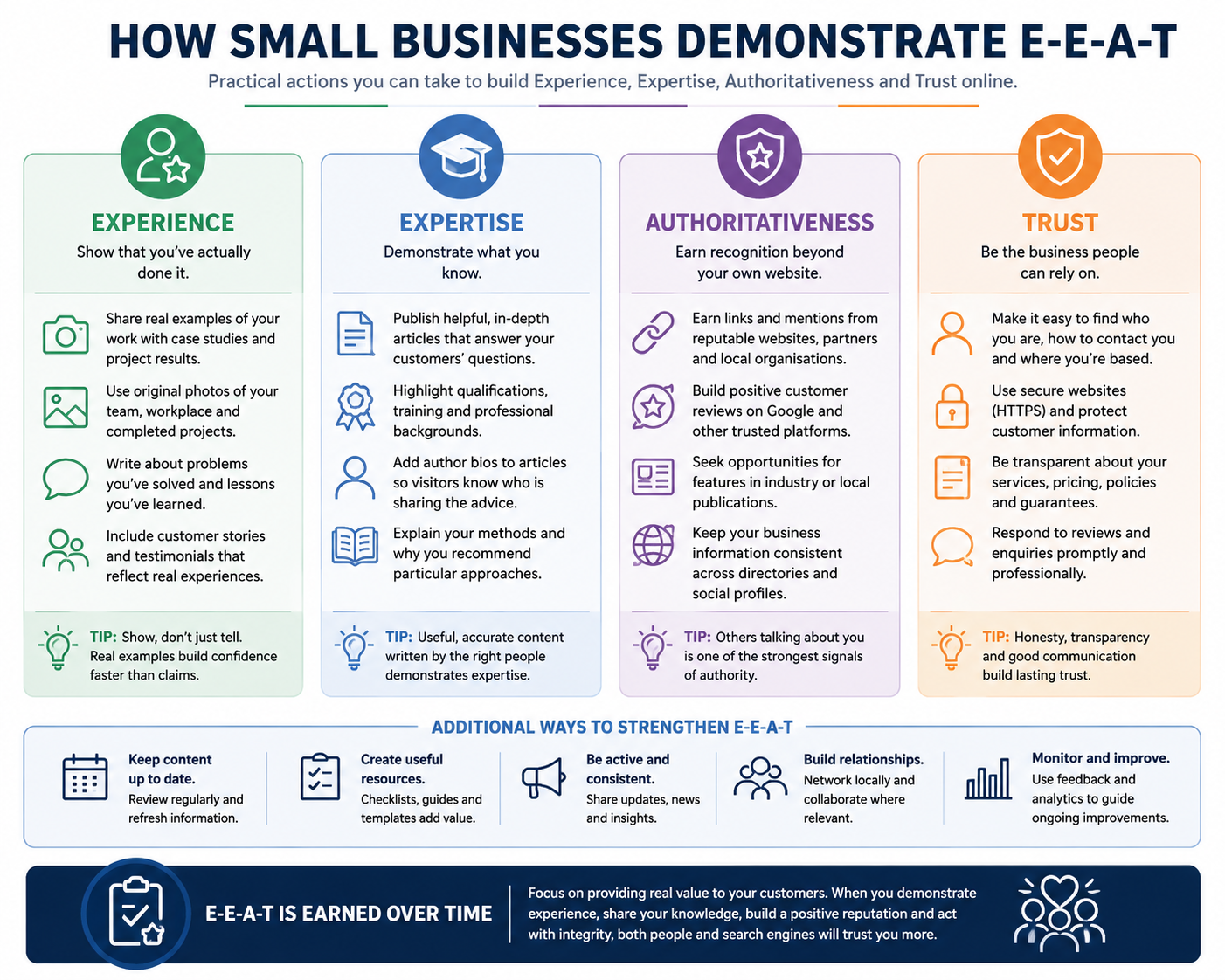
E-E-A-T stands for Experience, Expertise, Authoritativeness and Trustworthiness. These are qualities Google uses when assessing the credibility and usefulness of online content, but they are also useful principles for thinking about how potential customers judge your business online.
For a small business, E-E-A-T isn’t simply about search engine optimisation. A potential customer may look at your website, read your About page, check your Google Business Profile, browse customer reviews or search for information about your business elsewhere before deciding whether to contact you.
Each of these interactions can provide evidence of who you are, what you know, the experience you have and whether your business appears credible and trustworthy.
The four elements can be considered quite simply:
- Experience – Can you demonstrate genuine, first-hand experience of the work you do?
- Expertise – Does your website and content demonstrate knowledge and understanding of your subject?
- Authoritativeness – Are there signals beyond your own website that support your reputation and credibility?
- Trustworthiness – Can customers clearly identify your business, contact you and have confidence that the information you provide is accurate and transparent?
The objective isn’t to add E-E-A-T signals simply for search engines. It is to build an online presence that gives both potential customers and search engines stronger reasons to understand and trust your business.
For a more detailed explanation of each of the four principles, read The Four Pillars of E-E-A-T: Building Trust and Authority Online on Digital Strategy.
Does Your Website Demonstrate Real Experience?
Potential customers want reassurance that the people behind a business have genuine experience of the products, services and advice they provide. Your website is one of the best places to demonstrate that experience.
Rather than simply telling visitors that you are experienced, look for opportunities to show evidence of the work you have actually done. This might include completed projects, case studies, examples of previous work, original photography, client testimonials or practical insights gained from working with customers.
For service businesses in particular, first-hand knowledge can also come through in the way you explain your subject. Discussing common problems you encounter, the decisions involved in a project and lessons learned from real situations can demonstrate experience far more effectively than broad claims about being an expert.
Useful ways to demonstrate experience include:
- Showing examples of genuine projects and completed work
- Developing case studies that explain the problem, approach and outcome
- Using original photographs and images where appropriate
- Including genuine customer testimonials and reviews
- Sharing practical observations based on work you have undertaken
- Explaining how your experience influences the advice or service you provide
You don’t need a large portfolio or dozens of case studies. A smaller number of relevant, authentic examples can provide valuable evidence that there are real people, real knowledge and real experience behind your business.
The important distinction is between claiming experience and demonstrating it. The more clearly your website can show what you have actually done, the easier it becomes for potential customers to understand why they should have confidence in your business.
Are You Demonstrating Your Expertise?
Having expertise and demonstrating it online are two different things. You may have spent years developing knowledge of your industry, but potential customers can only judge that expertise from the information and evidence available to them.
Your website should therefore help visitors understand who is providing the advice or service, what they know and why their knowledge is relevant to the problem the customer is trying to solve.
Useful, original content is one of the strongest ways to demonstrate this. Articles, guides, FAQs and resources that answer genuine customer questions allow you to share your knowledge while helping potential customers make more informed decisions.
Other ways to demonstrate expertise include:
- Providing meaningful information about the people behind the business, including relevant experience, qualifications and professional background.
- Publishing useful articles and guides that demonstrate knowledge rather than simply promoting your services.
- Answering common customer questions clearly, particularly those that require genuine subject knowledge.
- Explaining your approach and why you recommend particular solutions.
- Keeping important information current, especially in areas where advice, technology or industry practices change over time.
- Identifying the author of specialist content, so readers can understand who is providing the information and why they are qualified to discuss the subject.
Expertise doesn’t need to be expressed through complicated terminology. In fact, being able to explain a complex subject clearly and practically can be a stronger demonstration of expertise than filling a website with technical language.
The aim is not simply to tell visitors that you are an expert. It is to give them enough useful information and evidence to reach that conclusion for themselves.
What Does the Rest of the Web Say About Your Business?
Your website is only one part of your online presence. Potential customers — and search engines — can also encounter information about your business through Google Business Profile, customer reviews, online directories, professional profiles, social media, other websites and mentions of your business elsewhere online.
These external signals can help reinforce the credibility you’ve established on your own website. They can also create uncertainty when information is incomplete, inconsistent or contradicts what customers find elsewhere.
Important areas to consider include:
- Google Business Profile – An accurate, well-maintained profile helps confirm important information about your business and provides customers with reviews, photographs, services and contact details.
- Customer reviews – Genuine reviews provide independent evidence of other people’s experiences with your business and can be an important source of reassurance for potential customers.
- Business listings and citations – Consistent information across reputable directories and business listings helps establish a clear online identity.
- Links from other websites – Relevant links can demonstrate relationships with other businesses, organisations, professional bodies or useful industry resources.
- Independent mentions – References to your business, projects or expertise on other credible websites can contribute to your wider reputation.
- Professional profiles – LinkedIn and relevant industry or professional profiles can provide additional evidence about the people behind the business and their experience.
- Consistent information – Your business name, contact details, services and other important information should tell the same story wherever customers encounter you.
You cannot control everything that is written about your business online, nor should you try to. Independent reviews, links and mentions are valuable precisely because they come from sources beyond your own website.
What you can do is make sure the information you control is accurate and consistent, encourage genuine customer feedback, and gradually build a wider online presence that supports the reputation you want your business to have.
The stronger the relationship between what you say about your business and what customers can independently discover elsewhere, the more credible your overall online presence becomes.
Can Potential Customers Trust What They Find?
Trust is at the heart of E-E-A-T. A potential customer may be impressed by your experience and expertise, but they still need to feel confident that your business is genuine, professional and safe to deal with before they make contact.
Many of the signals that build trust are relatively simple. Customers want to know who they are dealing with, how to contact you, what you offer and whether the information they are reading is accurate and current.
Important trust signals include:
- Clear business information – Make it easy to identify who you are, what your business does and where you operate.
- Accessible contact details – Provide clear ways for customers to contact you, such as telephone, email, contact forms or other appropriate channels.
- Accurate and current information – Outdated services, incorrect opening hours, broken links or old contact details can quickly undermine confidence.
- A secure website – Your website should use HTTPS and follow appropriate security practices, particularly where visitors are submitting personal information.
- Privacy and legal information – Clear privacy, cookie and other relevant policies demonstrate transparency about how your website and business operate.
- Genuine reviews and testimonials – Feedback from real customers provides reassurance that other people have successfully dealt with your business.
- Consistent information across the web – Details on your website, Google Business Profile, directories and professional profiles should agree with one another.
- Clear ownership of content – Where you publish advice or specialist information, identifying who wrote it helps visitors understand where that information has come from.
Trust is rarely created by one individual feature. It develops from the combined impression created by your website, content, reviews, contact information and wider online presence.
Small inconsistencies can sometimes have a surprisingly large effect. A website might look professional, but an outdated copyright notice, broken contact form, incorrect business information or abandoned profile can introduce doubt at exactly the point when someone is deciding whether to get in touch.
Building trust therefore means looking at your online presence through the eyes of a potential customer and asking a simple question: does everything they find give them confidence that this is a credible business they would be comfortable dealing with?
Five Ways to Strengthen Your Online Credibility
Improving your online credibility doesn’t necessarily require a complete website redesign or a complicated SEO strategy. Often, the best place to start is by reviewing the information and evidence already available about your business and identifying where important trust signals are missing or could be strengthened.
Here are five practical areas to focus on:
- Review Your About Page
Make sure visitors can clearly understand who is behind the business, the experience you have and why you are qualified to provide the products, services or advice you offer. Avoid vague claims and concentrate on relevant, verifiable experience. - Show Evidence of Real Work
Add genuine examples of projects, case studies, original photography, customer testimonials or other evidence that demonstrates first-hand experience. Showing what you have actually done is usually more persuasive than simply describing your capabilities. - Review Your Google Business Profile and Online Listings
Check that your business information is complete, accurate and consistent. Review your contact details, services, photographs and customer reviews, and make sure important information agrees with what appears on your website. - Strengthen Your Expertise Through Useful Content
Publish articles, guides, FAQs and other useful resources that answer genuine customer questions and demonstrate your knowledge. Where appropriate, identify the author and provide relevant information about their experience or professional background. - Check Your Wider Online Footprint
Search for your business and key people associated with it. Look at what potential customers can discover through reviews, directories, professional profiles, social media and other websites. Correct inaccurate information where you can and identify opportunities to strengthen your wider reputation.
None of these activities needs to happen overnight. E-E-A-T is better viewed as an ongoing process of building and demonstrating credibility rather than a checklist that can simply be completed once.
Start with the areas that are weakest or most important to your customers, make practical improvements and continue strengthening the evidence that supports your business over time.
E-E-A-T Is Part of a Bigger Picture
E-E-A-T shouldn’t be treated as a standalone SEO exercise. The signals that demonstrate experience, expertise, authoritativeness and trust are created across your entire digital presence and through the way your business operates online.
Your website may demonstrate your experience and expertise, while your Google Business Profile, customer reviews, professional profiles, external mentions and links help reinforce your reputation elsewhere. Useful content can answer potential customers’ questions, while accurate business information and a secure, well-maintained website help build confidence.
These elements work together:
- Your website provides the foundation for explaining who you are, what you do and why customers should choose you.
- SEO helps search engines understand your content and makes it easier for potential customers to discover your business.
- Google Business Profile and Local Search strengthen your visibility and credibility with customers searching locally.
- Useful content demonstrates knowledge, experience and understanding of the questions your customers are asking.
- Reviews and testimonials provide independent evidence of genuine customer experiences.
- External mentions, profiles and links help establish a wider picture of your business beyond your own website.
This is why improving online credibility often requires looking beyond one page, one platform or one marketing activity. A strong digital presence comes from ensuring these different elements support one another and present a consistent, credible picture of your business.
For small businesses, that doesn’t mean trying to improve everything at once. It means understanding where the weaknesses and opportunities are, deciding what matters most and making practical improvements in the right order.
That wider view is also where digital consultancy can be particularly valuable: helping you understand how the different parts of your online presence work together and where your time and investment are likely to have the greatest impact.
Want an Independent View of Your Online Presence?
It isn’t always easy to assess your own online presence objectively. When you’re close to your business, familiar with your website and responsible for managing different digital channels, weaknesses and missed opportunities can easily go unnoticed.
Digital Direction provides practical, independent digital consultancy to help small businesses understand how effectively their online presence is supporting their business goals.
We can review the different elements of your digital presence — including your website, search visibility, Google Business Profile, content and wider online footprint — to identify areas that may be affecting your visibility, credibility or ability to attract and convert potential customers.
Depending on your requirements, this could involve a focused review of a particular issue or a broader Digital Health Check to establish where improvements are likely to have the greatest impact.
The objective isn’t to recommend services you don’t need. It’s to give you a clearer understanding of where you are now, what could be improved and the practical steps you can take next.
Want to strengthen your business’s online presence? Arrange your free consultation with Digital Direction to discuss your goals and find out how we can help.