
Conchango & EMC Consulting – Building a Career in Digital Consultancy
Six formative years working with major organisations helped turn a specialist front-end development career into one centred on digital consultancy, UX, Agile delivery and solving complex business problems.
Introduction
Joining Conchango in 2004 marked an important turning point in my career. I arrived as an experienced interface developer, but working within one of the UK’s leading digital consultancies exposed me to a much broader world of client-facing consultancy, UX and user-centred design, Agile delivery and large-scale digital projects.
Over the following six years, through Conchango and subsequently EMC Consulting, I worked with organisations across financial services, retail, telecommunications, media and entertainment. It was an experience that shaped not only the work I did then, but the way I have approached digital consultancy ever since.
Learning the Consultancy Approach
Conchango gave me something that went well beyond technical experience. Working within a consultancy meant understanding the client’s objectives, communicating with business and technical stakeholders, and helping to determine the right solution rather than simply being handed something to build.
My role developed from specialist interface development into broader technical consultancy, UX considerations, development leadership and mentoring. Working alongside project managers, architects, designers and business stakeholders provided an understanding of how technology, business objectives and user needs have to come together for successful digital projects.
Working with Major Organisations
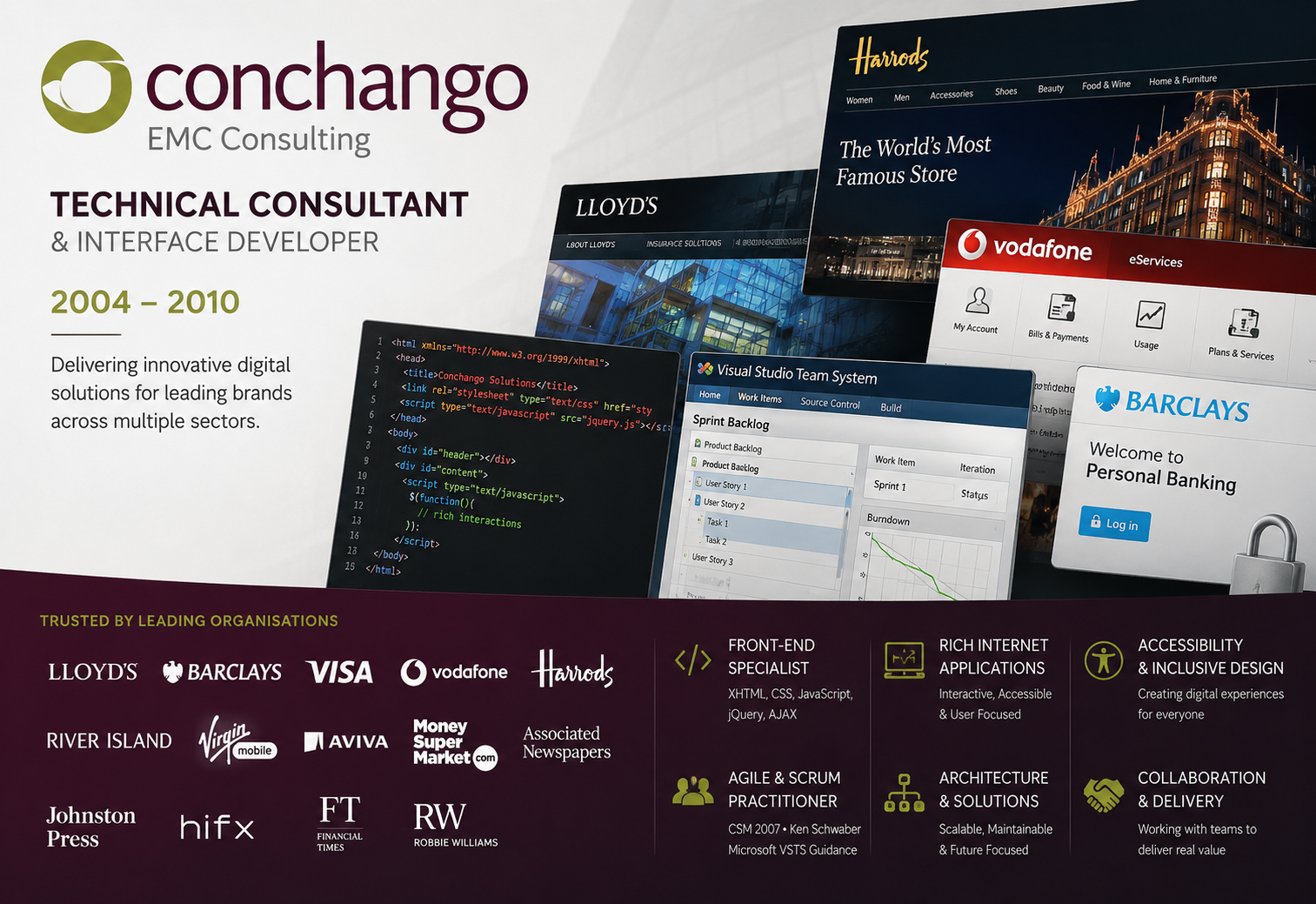
During my time with Conchango and EMC Consulting, I worked on projects for organisations including Lloyd’s of London, Barclays, Visa, Vodafone, Harrods, River Island, Virgin Mobile, HFiX, Axway, MoneySuperMarket, Associated Newspapers, Johnston Press, Microsoft, the Financial Times and Robbie Williams.
The assignments varied considerably. At Lloyd’s of London I was lead UI developer on the relaunch of its corporate website; at Harrods I led a team delivering interfaces for its ecommerce platform; and at Vodafone I worked on prototypes supporting its new European eServices style guide. This variety was an important part of learning how consultancy skills have to adapt to different organisations, users and business requirements.
Discovering Agile and Scrum
This period also introduced me to Agile delivery and Scrum. Beginning with the Lloyd’s project in 2004, I experienced first-hand how iterative development, close stakeholder collaboration and adaptive planning could improve the way digital projects were delivered.
I later became involved in Microsoft’s Visual Studio Team System Scrum Process Guidance project, working alongside Scrum co-creator Ken Schwaber. The experience helped establish an Agile foundation that would become an important part of my subsequent career as a Scrum Master, Agile practitioner and consultant.
An Experience That Still Influences My Work
My years at Conchango and EMC Consulting transformed the way I thought about digital work. Technology remained important, but understanding the organisation, its customers, its objectives and the problem being solved became equally important.
That principle continues to underpin my approach to digital consultancy today: start with the business need, understand the user, and then determine how digital technology can best support both.
Read the Full Project Story
This article provides a short overview of an important period in my consultancy career. For more detail about my work at Conchango and EMC Consulting, including individual client engagements, Microsoft innovation projects and the technologies involved, read the full Conchango/EMC Consulting project page on Mike-Speight.co.uk.